AI in the back office: how Australian businesses are using it in 2026, and what your organisation needs to have in place
06 August 2026
TechnologySHARE

AI tools are already present in most Australian workplaces — including in Finance, HR, and Business Support functions — whether or not organisations have a framework in place to manage their use. According to the Reserve Bank of Australia, adoption has frequently been employee-led rather than employer-led, meaning the tools often arrive before the policies do. This article covers where Australian businesses currently stand on AI adoption, what back-office teams are using AI for, and what organisations need to have in place to manage it effectively.
Where Australian businesses stand on AI in 2026
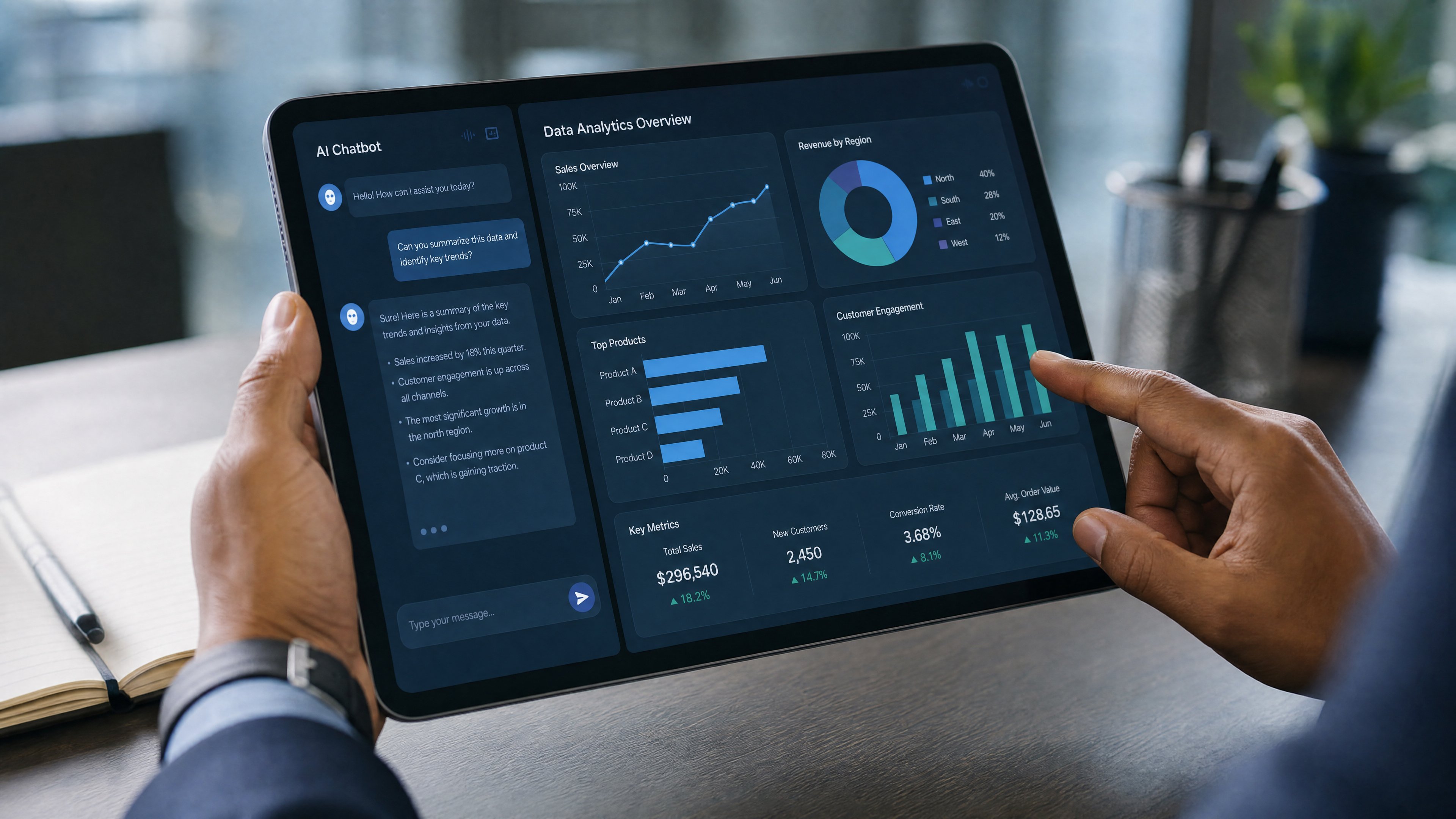
Across Australian workplaces, AI adoption has accelerated significantly over the past two years. The Australian Bureau of Statistics' 2024-25 Business Characteristics Survey — the most comprehensive government survey of its kind, covering nearly 7,000 businesses and conducted between October 2025 and February 2026 — found that AI adoption is increasing across all business sizes, with large businesses further ahead than small ones. Financial and insurance services recorded the highest growth rate of any industry surveyed, a finding consistent with broader trends showing that back-office intensive sectors are moving faster on AI than the overall average.
The data also shows a widening gap between innovation-active businesses — which are adopting AI at substantially higher rates — and those that are not. Two findings from recent research are particularly relevant for back-office teams. The Reserve Bank of Australia's 2025 survey found that AI adoption in Australian workplaces has often been employee-led rather than employer-led. The same survey found that returns on AI investment have been mixed to date, and that identifying high-impact use cases remains a priority for most organisations.
These patterns suggest that the question for most back-office teams is no longer whether AI is present in their workflows, but whether the organisation has a clear picture of how it is being used.
What back-office teams are actually using AI for
Across Finance, HR, and Business Support functions, AI tools are being applied to a growing range of everyday tasks. The applications vary in sophistication — from basic text generation to more integrated workflow automation — but the common thread is time-consuming, repetitive work that benefits from speed and consistency. The following examples reflect common use cases reported across Australian organisations.
Finance and Accounting: Automating Transactions & Reporting
AI tools are being used to draft financial reports and summaries, process and categorise transactions, identify anomalies in data sets, and support forecasting and scenario modelling. Document-heavy workflows — including invoice processing, expense management, and reconciliation — are among the areas where AI-assisted automation is most commonly applied.
HR and People Operations: Streamlining Recruitment & Onboarding
In HR, AI is being used to draft job descriptions and internal communications, summarise candidate applications, generate onboarding and training materials, and handle routine employee queries through automated response tools. Scheduling, meeting summaries, and policy document drafting are also common use cases.
Business support and administration : Embedding AI in Daily Workflows
Across general business support functions, AI tools are being applied to email drafting and summarisation, document review and extraction, data entry and formatting, and research and information gathering. AI features embedded in platforms that back-office teams already use — including Microsoft 365, Google Workspace, and accounting and HR software — are often the entry point.
A note on variation
The National AI Centre's AI Adoption Tracker identifies content generation and data analytics as the two leading use cases among Australian SMEs that have adopted AI, each reported by more than half of adopters. The specific tools and applications in use vary considerably across organisations, and the line between experimental use and embedded operational use is not always clear. What is consistent across the data is that back-office functions — particularly those involving document processing, communication, and data handling — are among the areas where AI is making the most immediate practical difference.
What organisations need to have in place
Given that AI adoption in Australian workplaces is frequently employee-led, many organisations will find that tools are already in use across their teams, sometimes without a clear organisational framework in place.
The following covers the areas that matter most for back-office teams and the organisations they work within.
Data Governance: Privacy Act 1988 and Australian Privacy Principles (APPs)
AI tools process the information that is entered into them. Where that information includes personal data, client records, confidential financial information, or commercially sensitive material, organisations remain subject to the Privacy Act 1988 and the Australian Privacy Principles (APPs), including APP 8 regarding cross-border disclosure of personal information to overseas recipients, and APP 11 regarding the security of personal information against misuse, interference, loss, and unauthorised access or disclosure. These obligations apply whether teams use free consumer AI tools or enterprise platforms. The key questions for any organisation are: what information are teams entering into AI tools, where is that data stored and processed, and is the tool being used subject to data protection terms that are consistent with the organisation's obligations?
Auditing shadow AI use across the organisation
Before establishing formal governance, organisations need to identify what AI tools are being used across internal workflows, including tools adopted informally without organisational approval. A 2026 Salesforce survey found that 56 per cent of AI-using workers were operating outside any employer-approved framework. An audit of current AI tool use across teams — covering both formally approved tools and those adopted informally — provides the foundation for any governance or policy response.
Drafting an AI Use Policy: Templates and Government Guidance
A policy does not need to be complex to be effective. At a minimum, it should address what AI tools are approved for use within the organisation, what categories of information should not be entered into external AI tools, and who is responsible for decisions about AI adoption and oversight. The Guidance for AI Adoption, published by the National AI Centre and available at AI.gov.au, provides a practical framework for organisations at any stage of adoption.
Evaluate tools before committing to them
Where an organisation is considering adopting an AI tool at a team or organisational level — rather than an individual using a general-purpose tool — a basic vendor evaluation is appropriate. This should cover the tool's data storage location, what the vendor does with data entered by users, whether the tool meets relevant security standards, and what the support and update commitments are. AI.gov.au provides guidance on evaluating AI tools, and the ACSC's Essential Eight framework provides a broader security baseline relevant to any software adoption decision.
AI adoption in Australian back-office functions is no longer a future consideration. The data from the Australian Bureau of Statistics, the Reserve Bank of Australia, and the National AI Centre all point in the same direction: AI tools are in use, adoption is accelerating, and the gap between organisations that are managing it deliberately and those that are not is widening.
For most back-office teams, the practical starting point is not a large-scale technology investment. It is understanding what tools are already in use, what data is being entered into them, and whether a basic policy framework is in place. The National AI Centre's Guidance for AI Adoption, available at AI.gov.au, provides a structured and proportionate starting point for organisations at any stage.
For advice on data privacy obligations, vendor evaluation, or building an AI governance framework suited to a specific organisation's circumstances, consult a privacy or technology law specialist, or refer to the OAIC and ACSC directly.
Official sources:
Australian Bureau of Statistics — Business Characteristics Survey 2024-25
National AI Centre — AI adoption insights: December 2025 to February 2026
Last updated: August 2026
SHARE